

















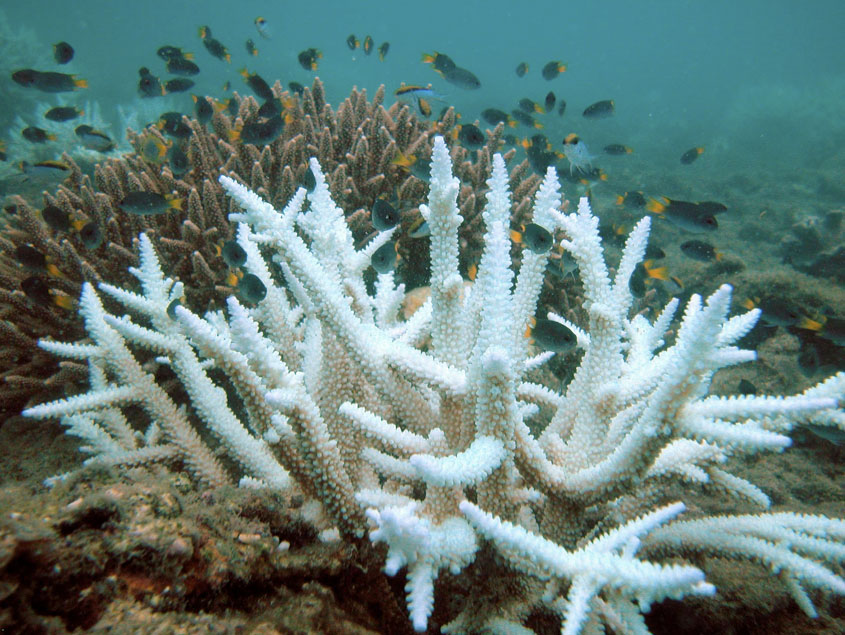
One result of climate change has been heightened awareness of the issue, including among Archbishop Carroll students. Another may be widespread coral death, according to a recently released report written by more than 100 scientists from almost two dozen countries.
For one Carroll student, awareness of global warming has led to concern about it.
“I worry about climate change and its effects on the Earth,” said Nathan Ciesinski, a ninth grader.
Another said he isn’t concerned right now but may be for the future.
“I think that climate change is not something to worry about, but in the near future, there is a high chance that it could be,” ninth grader Daryl Williams said. “If coral reefs died, I would be upset because a piece of the Earth would be lost.”
The death of coral reefs is considered a climate change ‘tipping point’ — a point of no return for a major ecosystem, according to a 2024 article by Martina Igini published by Earth.org. The Intergovernmental Panel on Climate Change (IPCC) describes tipping points like this: “critical thresholds in a system that, when exceeded, can lead to a significant change in the state of the system, often with an understanding that the change is irreversible,” Igini wrote. In other words, the change is so big, it probably can’t go back to the way it used to be.
An ecosystem is a set of things — both living, like plants and animals, and nonliving, like rocks, air, and water — that work together for life to continue in that system. Scientists say major ecosystems are being affected by climate change — specifically, warming. Once a climate change tipping point is reached for one ecosystem, some scientists say it can accelerate global warming, according to the Earth.org article, and cause damage to the Earth’s overall climate system — the system of land, sea, air, and living things that maintains weather patterns to sustain life on Earth.
Among tipping points listed by the IPCC are increased ice loss in the Arctic and Antarctic, loss of the Amazon rainforest, and loss of coral reefs. The Global Tipping Points report, written by the University of Exeter, England, and more than 80 other institutions and including the work of 160 scientists from 23 countries, contends the coral reefs die-off tipping point has been reached, according to a story last month by Graham Readfearn of The Guardian.
When global temperatures reached between 1 degrees Celsius and 1.5 degrees Celsius above where they were in the latter half of the 19th century, with a central estimate of 1.2 degrees Celsius, coral reefs hit a tipping point, according to The Guardian story.
“We can no longer talk about tipping points as a future risk,” said Professor Tim Lenton of the University of Exeter’s Global Systems Institute, according to The Guardian. “The first tipping of widespread dieback of warm water coral reefs is already under way.”
Not everyone agrees with Lenton’s conclusion. Another coral reef scientist, Professor Peter Mumby of the University of Queensland in Australia said the coral reefs are declining but could adapt to the new, warmer ocean temperatures, according to The Guardian.
Even though coral reefs only cover less than one percent of the ocean floor, they are home to 25 percent of the world’s marine life, according to the World Economic Forum. In addition, coral reefs provide $9.9 trillion in economic value each year stemming from fishing, tourism, and the protection of coastal areas, the World Economic Forum said.
Since 2009, 14 percent of coral reefs have disappeared, according to the Global Coral Reef Monitoring Network.